DISCLAIMER

DISCLAIMER: I do not attempt to be polite or partisan in my articles, merely truthful. If you are a partisan and believe that the letter after the name of a politician is more important then their policies, I suggest that you stop reading and leave this site immediately--there is nothing here for you.

Modern American politics are corrupt, hyper-partisan, and gridlocked, yet the mainstream media has failed to cover this as anything but politics as usual. This blog allows me to post my views, analysis and criticisms which are too confrontational for posting in mainstream outlets.

I am your host, Josh Sager--a progressive activist, political writer and occupier--and I welcome you to SarcasticLiberal.blogspot.com
Showing posts with label Corruption. Show all posts

Wednesday, July 4, 2012

The 2012 Farm Bill and its Consequences


© 7/1/12 Josh Sager – www.SarcasticLiberal.blogspot.com


The United States government periodically passes or re-authorizes federal farm bills in order to govern issues involving agriculture - issues including regulations, subsidies, environmental protections and trade. The 2012 Farm Bill, formally referred to as the “Agriculture Reform, Food and Jobs Act of 2012”, is a gigantic, omnibus bill, stretching over 1000 pages and costing approximately
$1 trillion dollars during the next decade. 
Due to its size and expansive nature, this bill will have wide reaching effects on issues of farming, conservation and food for individuals across the country. To put the sheer size of the 2012 farm bill into perspective: According to estimates by the Obama administration, the Iraq war cost the USA just over $1 trillion in direct costs over the last decade – nearly identical to the projected costs of the 2012 Farm Bill.


Unfortunately, while the 2012 farm bill is still being debated in the legislature, thus many details are yet to be determined, there are several disheartening initiatives which are virtually certain to pass, regardless of the final wording of the bill: The SNAP program (food stamps) will likely receive significant cuts and genetically modified crops will be shielded from disclosing their unnatural natures on packaging.


SNAP Program Cuts
Both the House and Senate versions of the 2012 Farm Bill include budget cuts to the SNAP (Supplemental Nutrition Assistance) Program, thus the only question surrounding the cuts is one of scale. The Senate version of the Farm Bill cuts $4.5 billion of federal funding out of the SNAP program ($450 million per year) and would impose new restrictions on eligibility in order to cut costs. The House Republicans are pushing for $134 billion in cuts ($13.3 billion per year) to the SNAP Program and will likely attempt to attach these cuts to the Farm Bill before they take a vote on it. It is likely that neither side will get the cuts that they desire, but rather that the final result will be somewhere between 4.5 and 134 billion dollars in cuts.


The Senate version of the Farm bill trims the edges off of the SNAP program, cutting 5.7% out of the $78 billion dollar a year SNAP program, while the House Republican plan would likely cripple the program by cutting 17% of its funding. Regardless of what the final cuts to SNAP are, the results will be painful for those dependent upon food stamps and will likely harm the economy. 


The SNAP program is a vital program and has been effective in both assisting poor families to feed themselves and stimulating the economy. Cuts to the SNAP program will likely lead to serious hardship for the poor, and a slowdown of economic growth caused by a decrease in demand for food. Millions of Americans, many of whom are children, are kept fed through funds provided by the SNAP program, and cuts to this program will cause these people to suffer. In addition to the humanitarian aspect of the SNAP Program, it has a very beneficial economic effect: SNAP food assistance has an economic multiplier effect of approximately 1.7 (for every $1 spent, it stimulates demand by $1.70), and is much more effective at stimulating the economy than any known tax cut; decreases in this program’s funding will lead to decreased demand and a slowdown of economic growth across the entire economy.


Shielding GMO Products from Disclosure
The 2012 Farm Bill will help shield producers of genetically modified crops from being forced to disclose the fact that their products have been modified. Few people realize just how many goods that they encounter on a regular basis are genetically modified, thus they are unable to make rational choices as to their consumption of genetically modified goods. Unfortunately, an amendment, proposed by Rep. Bernie Sanders (I-VT), that would force food companies to post whether or not their product contains genetically modified organisms was struck down in a bipartisan vote; the 2012 Farm Bill will inevitably perpetuate the concealment of which goods contain genetically modified organisms in order to protect food companies.


Genetically modified organisms (GMOs) are organisms, many times crops or food animals, which have been modified by human genetic manipulation technologies to be superior (theoretically) to the original organisms. These modifications take many forms, ranging from pesticide resistant crops (ex. Monsanto’s “roundup ready” GE corn) to foods with enhanced nutritional aspects (ex. “golden rice”), and are often marketed as the next evolution of crop sciences. 


The genetic modification of crops is a multi-billion dollar a year industry, utilized by numerous multi-national corporations. There are innumerable goods, including most processed foods, which contain some level of genetically engineered crop – follow this link to a list of common goods containing GMOs. Of particular importance when looking at the spread of GE crops are the corn and sugar beet goods created by the Monsanto Corporation; these crops are the primary sources of corn and beet sugar that eventually become glucose, fructose, and high fructose corn syrup which are added to virtually all processed foods. 


While they are marketed as safe, some genetically modified goods have been shown to have serious adverse side effects. Sometimes the splicing of one crop’s genetic code into another’s can lead to allergic reactions; this is particularly dangerous as the consumer may not even know that they are eating a food which contains a food they are deathly allergic to. In 1996, soybeans that had been spliced with brazil-nuts caused some people to unknowingly consume brazil-nut genetic material and suffer severe allergic reactions.


In addition to allergic reactions, there is the potential that genetically modified foods which are resistant to pesticides or produce their own pesticides may be toxic for human consumption. A recent study indicates that “roundup ready” corn, a GMO produced by Monsanto Co., may cause organ damage to mammals; while there haven’t been confirmed cases of human organ damage from this good, it is a very real possibility that such damage could occur given long-term consumption of GM corn. At particular risk for harm due to GMO crop pesticides are developing fetuses, as their tissues are far more susceptible to chemical poisoning (similar to why pregnant women should not drink alcohol or intake nicotine).

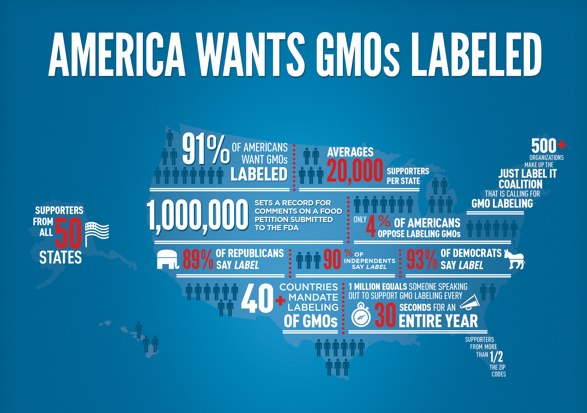
Given the potential consequences of unknowingly consuming genetically engineered products, it is simple common sense that people should be warned as to what they are eating; this is not to ban GMOs, but rather to ensure that consumers know just what they are buying and allowing them to make rational choices. The public opinion polling on the mandated disclosure of GMOs in food is heavily in favor of disclosure: A recent poll by Reuters concluded that 93% of Americans believe that genetically modified goods should be labeled for consumers. Individuals should be told what is in the food which they are buying and then be allowed to make a rational choice; the only way that this can occur is if all GMO-containing products are clearly labeled as such.


If an individual chooses to avoid genetically modified crops – whether it be health concerns, religious reasons, or simply a personal preference – it is an individual’s right to do so. Unfortunately, as there are no current regulations that force food suppliers to label goods which contain GMOs, it is virtually impossible for the casual consumer to determine just what they are eating. 


In the debate over the 2012 Farm Bill, Rep Bernie Sanders proposed an amendment which would require companies to disclose whether their products contain GMOs on its packaging; this amendment failed by a bipartisan vote of 73 to 26 in the Senate. As this amendment failed in the Senate by such a significant margin, it is essentially impossible that it will be included in the final bill (particularly because the House is even more hostile to such disclosure than the Senate). With the failed attempt by Rep Sanders to amend the 2012 Farm bill to include new disclosure regulations, it seems likely that such disclosure will not happen in the near future.


Without a federal law mandating disclosure of genetically modified materials in food, there is virtually no way for such laws to be enacted. On the state level, any attempt to pass legislation mandating disclosure would either fail to pass, or meet lawsuits by every major genetic engineering corporation. The threat of such lawsuits by powerful corporations presents a virtually insurmountable obstacle for any state level attempts to force disclosure, even on a smaller level. This is one issue that simply must be fought on the federal level and, unfortunately, this battle seems lost for now.

Tuesday, June 26, 2012

Use Knox V. SEIU to Attack Money in Politics


Use Knox V. SEIU to Attack Money in Politics
© 6/24/2012 - Josh Sager
781-864-4572

Background
Money in Politics

The modern political era has been party to massive regressions in campaign finance law, as well as corresponding increases in political spending by wealthy groups and individuals. Over the past 40 years, a series of judicial decisions and precedent interpretations have opened the floodgates, allowing a tsunami of money to overtake the political process. This money, originating from corporations, unions, wealthy individuals and advocacy groups, has sculpted the political landscape into one of gridlock and legalized corruption.

Arguably, the first step in the journey which led to the current political climate was the 1886 Supreme Court decision Santa Clara County v. Southern Pacific Railroad. This case’s decision was a vital prerequisite for the current political climate because it was the seed from which “corporate personhood grew. The resolution of a tax dispute between the local government of Santa Clara, CA, and the Southern Pacific railroad led to the including of corporations in the 14th amendment to the Constitution. Interpretations of this case led to a granting of some human rights, most importantly the 1st amendment right to free speech, to American corporations. This decision, while dormant and largely inconsequential in regard to politics for many years, has become the foundation of the argument which allows corporations to spend money in our elections. By giving corporations the human right to free speech, the Supreme Court created a situation where they could not be restricted from “speaking” about political matters. 

In 1976, the Supreme Court decision Buckley V. Valeo redefined monetary donations as just another form of free expression, virtually synonymous with normal speech; while this decision upheld the concept that monetary donations in politics can be limited, its redefinition of money as speech made future regulations of donations very difficult. Due to this decision, donating money became protected speech, and donations to political groups became synonymous with verbal support. The precedent set by Buckley V. Valeo rendered the Santa Clara County v. Southern Pacific Railroad interpretation a vital Supreme Court precedent, as their interaction created a situation where corporations had a protected right to spend money in elections.

The now-infamous Citizens United v. Federal Elections Commission decision of 2010 was the decision which finally broke the dam holding back money in politics. Before the Citizens United decision, monetary expenditure, while considered speech, were held in check by limits to the monetary amount which can be donated during campaigns; these limits prevented wealthy individual, as well as non-human collections of wealth (ex. Corporations and unions), from donating unlimited sums of money in support of their political candidates. Citizens United v. FEC rendered limits on campaign spending to be unconstitutional, thus it led to the explosion of money in politics.

Despite the recent public focus on the judicial mistake know as Citizens United v. FEC, the flood of money into politics was not caused by a single Supreme Court decision; it was brought about through a combination of several decisions, interacting within the law and incrementally increasing the power of money in politics. The granting of human rights to corporations led to a level playing field between individuals and corporation, essentially granting corporations the rights of humans without the legal liabilities or inconvenience of a conscience. The redefining of monetary donations as speech led to corporations, which were then considered people, being given the right to “speak” with their money up to the very limits of the legal campaign donations. The proverbial straw which broke the camel’s back in the fight to keep money out of politics, was the removal of campaign donation limits; this decision led to a proportional level of power based upon money rather than votes – turning our political system from one where “one person equals one vote” to one where “one dollar equals one vote”.

Recently, several groups have been attacking corporate personhood, the synonymy of money with speech, and unlimited campaign donations in order to return integrity to our political process. As the primary causes of the recent political crisis are interpretations of the constitution by the Supreme Court, the only remedies to this crisis have become a constitutional amendment or another decision by the Supreme Court superseding their current stance.

Ultimately, as Supreme Court decisions can be changed, the only long-term solution to the problem of money in politics is a constitutional amendment banning money from political campaigns. Despite its ineffectiveness as a long term fix, a decision by the Supreme Court increasing the difficulty corporations have while donating money to politicians would help stem the flow of money into politics. I believe that such an opportunity to challenge the current political donation law was opened up by the decision of Knox v. SEIU.

Knox V. SEIU

During the 2012 term of the Supreme Court, the court heard and decided upon the case of Knox v. SEIU. This case, and the precedent it sets, involves the rights of public unions to compel donations from their members for the express purpose of political speech.

In 2005, the California Service Employees International Union (SEIU) attempted to increase its members’ dues for a temporary increase in political spending during the upcoming 2006 political cycle; this increase was minor for each person paying union dues, totaling a sum of $6.45 a month, yet some people objected. Several non-union members, who still paid union dues to their support collective bargaining (referred to as “chargeable expenses”), challenged the increase due to their disagreement with the recipient of the political expenditures of the union; these people sued the SEIU to stop their money from supporting political speech which they didn’t agree with, and, in January 2012, the court was heard by the United States Supreme Court.

The decision in Knox v. SEIU, derived from a 7-2 ruling and written by Samuel Alito, decided that the SEIU had violated the 1st Amendment rights of its members by compelling a political donation without prior consent. This decision rested heavily upon the compulsion of belonging to a union, thus supporting political speech by the union, created by current law. Since people were mandated by the government to pay SEIU dues, and these dues were considered “political speech” (due the Buckley v. Valeo defining money as speech and United States v. United Foods Inc. defining compulsory political speech as unconstitutional), the government was determined to be mandating speech. As the government cannot mandate political speech under the 1st amendment, the Supreme Court decided that the SEIU increasing political “speech” without consent was unconstitutional. 

Current California state and federal law allows for the creation of “union shops” - places of business that require workers to pay union dues, regardless of whether they are union members – and supports the compulsion that all workers must pay union dues. Knox v. SEIU separates the primary goal of the union, collective bargaining, from the secondary goal of political input, and names it unconstitutional for a public sector union to compel donations aimed at political speech.

From the Syllabus of the case, explaining current stare decisis on compulsory speech
When a State establishes an “agency shop” that exacts compulsory union fees as a condition of public employment, “[t]he dissenting employee is forced to support financially an organization with whose principles and demands he may disagree.”   Ellis  v.  Railway Clerks, 466 U. S. 435, 455.  This form of compelled speech and association imposes a “significant impingement on First Amendment rights.”  Ibid.  The justification for permitting a union to collect fees from nonmembers—to prevent them from free-riding on the union’s efforts—is an anomaly.  Similarly, requiring objecting nonmembers to opt out of paying the nonchargeable portion of union dues―rather than exempting them unless they opt in―represents a remarkable boon for unions, creating a risk that the fees nonmembers pay will be used to further political and ideological  ends  with  which  they  do  not  agree. Thus, Hudson, far from calling for a balancing of rights or interests, made it clear that any procedure for exacting fees from unwilling contributors must be “carefully tailored to minimize the infringement” of free speech rights, 475 U. S. 302−303, and it cited cases holding that measures burdening the freedom of speech or association must serve a compelling interest and must not be significantly broader than necessary to serve that interest. – Knox v. SEIU Syllabus, Pg. 3

The central premise of Knox v. SEIU can be condensed down to a very simple question: Can an organization which the government mandates citizens to financially support compel those mandated to support it pay additional fees - without prior consent – aimed at supporting the organization’s political speech? The decision of Knox v. SEIU clearly states that such compelled donations without prior consent are unconstitutional infringements upon the 1st Amendment.

Excerpt from the opinions of the court - Pg. 2 - written by Samuel Alito in concurrence with Justices Roberts, Scalia, Thomas, Kennedy, Sotomayor, and Ginsberg.
“The First Amendment, we held, does not permit a public-sector union to adopt procedures that have the effect of requiring objecting nonmembers to lend the union money to be used for political, ideological, and other purposes not germane to collective bargaining.”

The ultimate result of Knox v. SEIU is that public sector unions will no longer be able to compel political donations from members who don’t give prior consent to their funds being used for political speech. While unions are acknowledged to provide a primary service to all workers in a workplace, thus these workers must pay union dues regardless of personal preference, the secondary goals of these unions cannot compel increased funding; in short, by defining the primary purpose of public sector unions as the facilitation of collective bargaining and separating this purpose from that of political spending, the court has reduced the ability of unions to compel funds for their political speech.

Proposal
Introduction

With the precedent set by the recent Supreme Court Decision Knox v. SEIU, I see the potential for a new line of attack on corporate interests donating money. Instead of simply attempting to attack large aggregations of wealth and power’ (ex. corporations and unions) right to spend money in elections, citizens can use Knox v. SEIU to attack such donations through the argument that such groups are unconstitutionally compelling donations from the public.

Public sector unions are not the only groups which utilize government laws and regulations to compel citizens to pay for their activities: Corporations which receives government contracts (ex. Lockheed Martin), corporations whose stock is purchased by public pension funds (ex. blue-chip stocks), military and privatized public good suppliers (ex. private prison corporations), are simply three examples of situation where the public is compelled to invest in a corporation. A corporation which receives government money is receiving funds obtained through the mandated payment of taxes on the public; as there is no way to opt out of taxes or directly control the flow of tax revenue to prohibit the giving of tax money to specific corporations (ex. saying that none of your taxes shall go to Exxon Mobil), the government is essentially forcing taxpayers to support specific corporations.

As with the government mandating workers in a union shop to pay the SEIU for their promotion of collective bargaining, it is entirely proper for the government to compel citizens to pay for the corporate contracts utilized by the government to provide for society; tax income has regularly been used to contract the provision of public services and goods to private corporations (ex. military weapons contracts). The problem emerges when the same corporations which receive public funding, raised through mandated taxes, are spending money as “political speech”.

If a corporation which has received public money for a service chooses to engage in political speech (and, given the widespread use of lobbying combined with the propagation of corporate subsidies, this is essentially every large corporation) then the government is, in effect, mandating that the average taxpayer support said corporation’s political speech. Just as the SEIU attempted to use its funds to support its political “speech”, corporations utilize their profits to facilitate their own “speech”. Just as the SEIU benefits from government’s “agency shop” rules forcing all workers to support them monetarily, many corporations benefit from the government giving them funding raised through taxes.  

Put plainly, if the SEIU cannot utilize money collected through government compulsion for its political “speech”, as this would violate the 1st Amendment, no corporation receiving money from the government – money collected through compulsory taxation - should be able to utilize its funds for political speech. If Knox v. SEIU is applied to corporate entities rather than just public unions, as is proper under current free-speech law, corporations could still spend money in politics, just as long as they are barred from receiving any and all public assistance.

The banning of private organizations from receiving public monies based upon taxpayers’ objections to such organizations being granted public funds is not unprecedented: The “Title X” ban on abortion providers being paid through public funds, even if their actions are constitutionally protected, was upheld during the 1991 case Rust v. Sullivan. If it is constitutional for abortion providing corporations to be banned from receiving public subsidies (in the form of compulsory tax dollars), assisting them in performing their constitutionally protected services (abortions), then it is constitutional for the government to ban other corporations from receiving such funds to perform other constitutionally protected activities (ex. political speech). This is not to say that such organizations cannot act with private money, but rather that they must perform their constitutionally protected activities – whether abortion or political speech - with private funds.

I propose a legal challenge to the United States government, aimed specifically at expanding Knox v. SEIU to cover all corporate and union entities which receive public funds where there is no opt-out. Based upon current jurisprudence, this case would conform to the current law and would drastically reduce the amount of money in politics. If a corporation is forced to choose between the revenue which comes from government contracts, public sector pension investments, subsidies, grants, and contracts, and their ability to freely exercise their first amendment rights to free speech, it is likely that they will choose to relinquish their right to speak. By forcing large corporations to pick between their pocketbooks and their ability to influence politics, concerned citizens can force corporations to voluntarily disarm much of their political apparatuses.

As a favorable decision in this case would simply expand the constitutional interpretations of existing laws, there is no need to pass the partisan and gridlocked legislature. Given its past decisions of Citizens United v. FEC and Knox v. SEIU, an intellectually consistent Supreme Court would be forced to side with the challengers’’ interpretations of the law - under current law, political speech restrictions do not distinguish between unions and corporations, thus what applies to unions receiving compulsory funding would necessarily apply to corporations receiving the same. As this legal case does not challenge a specific ideology within free speech, it does not violate the constitutional ban against the government favoring specific types of speech; in fact, a Supreme Court denial of this interpretation would represent a discrimination of speech favoring corporations over unions.

Standing

Anybody who is currently paying taxes or paying into a government pension program could potentially have standing to challenge the constitutionality of their money being used to fund corporations’ political speech. As corporate profits are not separated by source, a portion of every taxpayer’s taxes, while small, is being used by corporations to fund their political speech. Under the Knox v. SEIU precedent, the use of such money violates the 1st Amendment right to free speech for every individual to be forced to pay the corporation.

Limitations

Even if the proposed case is successful, and a Supreme Court expands Knox v. SEIU to disarm corporations, this court case would not completely solve the problem of money in politics; a favorable decision would mitigate some of its effects, but not solve the problem at its source (similar to cutting a weed off at ground-level rather than pulling it up at its roots). The following list is of several limitations and complications which would accompany the legal fight and results (if successful) of the proposed legal case:
  1. 1.      The current Supreme Court is a highly partisan body and could potentially throw away its own precedent to support the sustainability of corporate power in politics. While this action would be so obviously hypocritical, given their Knox v. SEIU decision, that they would lose face in the public eye, however it is entirely possible that they would act so anyway.
  2. 2.      Once corporate groups became aware of the effort to cripple their funding streams, the response would likely be enormous. If these corporate groups believed their funding to be significantly threatened by this case, they would likely attempt to crush it with all available resources.
  3. 3.      501(c)(4) “Super-PACS” (ex. Crossroads GPS) are considered “social welfare organizations” rather than political groups, thus these groups will still be able to spend limitless amounts of money in politics.
  4. 4.      Wealthy individuals (ex. Sheldon Adelson) would be left completely untouched by this method of attacking money in politics. As individuals, not institutions, these rich people would be able to bypass the ban on publicly funded corporations and continue to spend limitless amounts of money as a form of political speech.
  5. 5.      The “revolving doors” of politics and regulatory agencies would still be operational, thus corrupt political agents would still be able to benefit from their corporate patronage; hopefully, by reducing the ability of corporations to support such politicians while seeking re-election, these politicians would be more vulnerable to unseating.
  6. 6.      As with all Supreme Court decisions, a future court can overrule this decision. Because of its lack of permanence, the use of the Supreme Court to challenge money in politics will always be inferior to the attempt grounded in pursuing a constitutional amendment.
  7. 7.      By intentionally expanding Knox v. SEIU to cover corporations, it is possible to reduce the money in politics from all groups, regardless of partisanship. Partisan actors are unlikely to get behind the effort to disarm their political apparatus’s funding stream, regardless of whether or not it also disarms their opponents.

Wednesday, June 20, 2012

Why Not to Trust Monsanto


Why Not to Trust Monsanto
© 2012 Josh Sager – SarcasticLiberal.blogspot.com
Open to publishing with attribution, but not alteration


All Credit for Graphic to Rasa13
The Monsanto Corporation is one of the largest pesticide and biotechnical corporation in the entire world; their products are used in most sectors of agriculture and can likely be found in most markets across the United States.  Monsanto is a multi-billion dollar company with a diverse product base and is among the largest producers of genetically engineered crops. As a company, Monsanto promises to be the creator of new, safer, pesticides as well as stronger bio-engineered crops. Unfortunately, the reality of what Monsanto will deliver to the world is likely very different from what they promise, or what we, as a society, desire.


Monsanto has produced many products, from new types of pesticide to genetically engineered crops, and has been the center of several severe controversies. In numerous cases, the Monsanto Corporation produced and marketed products which they knew to be potentially toxic, yet gained a profit from selling. While not illegal, largely due to their massive lobbying efforts reducing safety standards (Follow this link for the OpenSecrets.org report on Monsanto lobbying), the sale of toxic chemicals for a corporate profit is both highly immoral and very relevant to those in society who wish to assess the use of Monsanto products. Put plainly: Monsanto’s history of selling poison, labeled as a useful product, casts doubt on whether any product that they sell should be trusted (even if they claim it to be entirely safe, they have lied before).


During its early years, Monsanto was a major producer of PCBs (Polychlorinated biphenyl) to be used in various industrial applications. Monsanto was the primary North American supplier of PCBs from the 1930 to the late 1970s, when these chemicals were banned for their highly toxic nature. PCBs, while very stable and good at acting as a liquid insulator, are extremely toxic to virtually all forms of life – they are carcinogenic, highly toxic, and corrosive upon contact with skin or mucus membranes. Even with the mounting evidence of the toxicity of PCBs, Monsanto continued to produce them up until they were forced to stop by the government banning their production.


The Monsanto Corporation has a long and sometimes unfortunate history of creating new and powerful pesticides. The infamous “Agent Orange”, used in Vietnam to destroy jungles, and the powerful pesticide DDT were two of the primary pesticides produced by Monsanto during its early years. While Agent Orange and DDT are now outlawed due to the massive damage they cause human life as well as the environment, Monsanto continued producing them for as long as the law allowed. The gigantic costs to human health and to the environment caused by the sale of Monsanto pesticides, even once they were deemed too dangerous for use, resulted in many ruined lives and destroyed ecosystems for society but huge profits for Monsanto.


A large portion of Monsanto’s business is currently in the field of “genetically modified organisms” (otherwise known as GMOs); this simply means that they alter the genetic structures of crops in order to (hopefully) make them more resistant to disease, easier to grow, higher yield, or less susceptible to predation by pests. Unfortunately, GMOs are often plagued by unintended consequences and side effects of genetic modification which make them risky for human consumption. Monsanto has been embroiled in several serious controversies surrounding the safety of their GMO products – namely GE corn and recombinant bovine growth hormone – yet they have consistently continued to sell their goods. 

Just recently, a study published in the International Journal of Biological Sciences seems to indicate a link between the consumption of Monsanto genetically engineered corn and organ damage (primarily in the liver and kidneys). This damage is consistent with the genetically engineered pesticide utilized by the corn, and seems to refute Monsanto’s claim that the pesticide will degrade long before it is consumed. Despite evidence that Monsanto’s GM corn may cause organ damage in its consumers, they have refused to recall their products. The refusal to recall their potentially toxic corn, in combination with their history of damaging their consumers for a profit, shed considerable doubt upon their care for the health of those who consume their goods.


Monsanto’s corporate behavior, both historically and currently, demonstrates a prioritization of profits over the safety of their consumers. It is evident that Monsanto will sell products, regardless of whether they may be toxic, for as long as they are legally able to sell them. Not only does Monsanto have a pattern of selling toxic goods, but they lobby to prevent these goods from becoming illegal (even after determining their toxicity), thus compounding the harm that they cause society.


Monsanto may very well make some quality products but, given their pattern of negligence, there is no reason for the public to believe them when they promote their goods. The Monsanto Corporation has proven numerous times that it will sell poison for a personal profit, regardless of the harm which their products inflict upon society; in the absence of regulators sanctioning Monsanto for its negligence, it is up to the public to stand up to Monsanto and call them out for their bad acts.


The next time you hear the name Monsanto in relation to a good which you are thinking of buying, please reconsider your purchase. It is entirely possible that the food is safe, or even of higher quality than other food, but there is also the very real likelihood that this food will damage your body. Why gamble with your, or your family’s, health when there are so many other alternatives to the potentially toxic goods of Monsanto?

Thursday, June 7, 2012

Wisconsin Lost: The Test Case for a Post-Citizens United Political Landscape


By Josh Sager


In the face of the results from the recent Wisconsin recall election, several congratulations are in order: Congratulations to Governor Scott Walker for retaining his position of power, even in the face of a massive populist rejection of his policies. Congratulations to Walker for proving that, with enough money, even the most disliked and obviously corrupt politicians can remain in power. Congratulations to Walker for becoming the living example of why money must be removed from politics. Governor Walker’s attack on public sector union collective bargaining during the creation of the 2011 Wisconsin budget caused a virtual firestorm in the Wisconsin political landscape. Huge protests, including a massive sit-in at the statehouse, demonstrated just how controversial the union-busting amendment was to the general population. The reaction to the union-busting measures pushed by Walker became so extreme that numerous Democratic legislators actually fled the state in an attempt to block cloture (preventing a vote) on the budget. Unfortunately, the removal of collective bargaining rights eventually passed through the legislature - through the use of a highly controversial procedural loophole - and was signed by Walker. Throughout much of 2011, a large number of union and Democratic groups gathered signatures and organized in order to bring about recall elections of the politicians who support the union-busting measures. After a lengthy process, far more signatures than required were turned in and the recall was set. Unfortunately, a loophole in the Wisconsin election law, allowing for unlimited donations during recall elections, combined with the Citizen’s United V. FEC Supreme Court decision led to a situation where a figurative tsunami of money entered Wisconsin politics. The Wisconsin recall election has become a crystal ball into the future of American politics – a future where unlimited amounts of money are donated by anonymous billionaires and used to carpet-bomb the public with deceptive ads.

The following graphic, created by the Center for Public Integrity, demonstrates just how ridiculous the idea of unlimited donations is:


As you can see in the graphic, Scott Walker raised nearly eight times the amount of money then Tom Barrett, the Democratic challenger. A resource disparity of a factor of eight is absolutely ridiculous, and creates a virtually insurmountable obstacle for the party with the smaller amount of resources. With his vastly inferior resources, there was simply no way for Barrett to put up a credible fight against Walker. Unless we work to get rid of money in politics, it is likely that many future fundraising charts will look similar to this one – where the corporatist politician has virtually unlimited funding and the populist politician is left with virtually no way to fight back.
It is an unpleasant fact that people are fairly easy to trick, given enough organization and money supporting the effort; unfortunately, corporate political groups have both the money and the organizational knowledge to trick people into supporting their politicians. The major operational effect of removing the limits on political donations is that those with money will inevitably attempt to propagandize others to support their interests (regardless of whether this interests support those people). As the general public is usually ignorant about the specifics of policy, political dis-information campaigns regularly convince people to vote against their own interests or support candidates who are obviously not the best people for the job. Not only has the removal of donation limits led to the public being constantly bombarded with partisan propaganda, but loopholes in disclosure rules have led to thes campaigns being virtually anonymous; we simply don’t know who is giving to many major political groups (Ex. Crossroads GPS). Money in electoral politics used primarily to buy advertising and promote messaging. In political races where resources are largely equal between the parties, there is no way for one group to simply saturation-bomb the opposition with negative ads; for every ad that one side takes out, the other can respond and mitigate it with an opposing ad. Unlike in races where resource levels of the sides are similar, in races where the resource differential is large (Ex. a factor of eight), one side can buy up huge amounts of ad-space and overwhelm the other. The side with more resources simply buys huge amounts of advertising and drowns out the opposing side through sheer volume of propaganda. We have seen this phenomenon in the Republican primary race, where Romney used his superior resources to bludgeon the opposition – weak as it was – into submission, as well as in the recent Wisconsin recall. In less than a year, the propaganda campaign of Scott Walker transformed the atmosphere of protest - which spawned marches and fueled a massive recall effort – into one where he was able to capture over a third of the union households of Wisconsin. Even while the video of Walker discussing his “divide and conquer” strategy of breaking unions with a rich donor and the now-infamous “fake-Koch brother” audio tape circulated the internet, Walker was able to convince nearly a third of union households to vote for him. Propaganda works, but it requires money to propagate; due to his selling out to the rich, who desired unions be suppressed, Walker had all the money he needed to keep his position. In addition to the sheer volume of cash spent during the Walker recall, the sources of such money are absolutely vital to the understanding of the recall results. A majority (66% or $20.13 million) of Walker’s money came from out of state groups and individuals - agents which don’t actually have any stake in the recall, as they are not residing within the area of effect for the governor’s policies. These interests are national corporate groups looking to set a precedent, where repercussions against politicians who support anti-labor agendas are minimal. If politicians are emboldened to attack unions, because they no longer need to fear populist reprisals, more state politicians will be willing to sell out to corporate interests. A minority (34% or $10.37 million) of Walker’s fundraising came from in-state corporate interests and wealthy donors. Many of these donors benefit greatly from the reduction of labor rights within their state, because decreased union power depresses the wages for everybody. Tom Barrett raised a majority (74% or $2.886 million) of his money from in-state interests; a majority of this money came from unions groups and smaller donations. These groups are most likely those that are affected most by the union stripping measures of Walker, thus they had a compelling interest in recalling him. A vast minority (26% or $1.014 million) of the money raised by Barrett came from out of state donors. These donors consisted primarily of concerned liberals and union groups looking to impose punishments against Walker for his anti-union agenda. Just as corporate interest from other states desire a precedent of no consequences for selling out to corporations, unions desire accountability from these politicians.
To put the Walker recall funding source situation into perspective:

Scott WalkerTom BarrettDifferential
In-State Fundraising$10.37 million$2.886 million+359.3% to Walker
Out of State Fundraising$20.13 million$1.014 million+1985% to Walker


Not only did Walker raise far more money from donors, but a huge percentage of his donations came from out of state groups. While in-state Walker fundraising overtook Barrett’s by a factor of 359.3% (an incredible number), Walker’s out of state fundraising absolutely eclipsed Barrett’s by a factor of 1985%. The fact that Walker’s fundraising is so heavily skewed towards out of state donation points to the fact that union busting by corporate interests is a national issue. Unions in Wisconsin wanted to retain the ability to collectively bargain, but corporations are looking at a multi-state strategy. In essence, the Wisconsin unions and Tom Barrett were looking to serve the interest of their supporters in Wisconsin, while corporations and Scott Walker were looking to advance the national corporate fight against unions. Realistically, unions and interest groups looking out for average citizens will never be able to compete monetarily against corporate groups and individual billionaire donors. Corporations simply have too much money and unions will never be able to compete on an even playing field. This fundamental disparity in resources, combined with a system of unlimited political donations, leads to an unbalancing of the political playing field: the rich and corporations gain an advantage and slowly take over the political system. 

As demonstrated by the Walker recall, money in politics has a clear and devastating effect on the race. On average, the side with drastically more money wins the race against the side with more limited resources. Corporate money flows to the politicians who sell out to the interests of these corporations – reducing corporate taxes/regulation and giving them contracts – thus the corporate politicians will eventually take over any area where money is unrestricted. The attempted recall of Scott Walker, precipitated by his attacks on labor rights in Wisconsin, was the first large test of corporate money versus people - Unfortunately, in this case, money won. While it wasn't surrounding a particularly important political position, in the gard scheme of things, the recall fight against the Wisconsin Governor gave us a window into the future of politics. Huge amounts of money, oftentimes donated from groups not affected directly by the results of the elections, swamp the population with messaging. This messaging convinces the population to vote against their own interests and creates a self-sustaining cycle of corporations buying election after election. 
We must remove money from politics, lest our entire system of government become little more than a public auction between different corporate interest groups. We, as Americans, must organize and prevent all future elections from being as unbalanced as the recent Wisconsin recall. It isn't too late to act against corporate power in elections but we must act now, before the corporate interests capture the government even more than they have already. The only feasible method of barring money from elections is through a constitutional amendment. Several groups are working towards this goal, but they need help. Please, regardless of partisanship, donate your time and resources towards one of these groups and join the effort to protect American democracy.

Wednesday, June 6, 2012

The Effects of Corporate Lobbying, Pt. 3: Take Action


The Effects of Corporate Lobbying, Pt. 3: Take Action

By Josh Sager

Should citizens work towards getting money out of politics?

In a word, yes. The American people must fight against money in politics if we wish to have any influence in our government and, by extension, public policy.
The US government was originally intended to be a constitutional republic, where voters decide upon representatives who represent their interests. Unfortunately, lobbying and the extreme increase of money in politics have perverted the integrity of our government to the point where policy is tailored to the rich. While it may be possible for some citizens to recapture control over their elected officials, lobbyist money will still control the government in aggregate. The only way that the USA will return to a country where the will of the population controls policy is a complete reform of lobbying and campaign finance reform. 
But how do we do this?
Unfortunately, the problem of money in politics is very difficult to solve using traditional politics; the system is so bought by interests that it is virtually impossible for citizens to push money out of power. With the Citizen’s United v. FEC decision classifying money as speech, there are only three realistic methods by which money will leave politics:
  1. Another decision by the Supreme Court – As the Supreme Court is not elected, there is no way for the population to push for this, nor is it likely that the currently corporate-friendly court will change its decision.
  2. A constitutional amendment – By pushing for a constitutional amendment banning money as speech, Americans can get around Citizens United and virtually ensure that money will lose control over policy. A constitutional amendment can be created by the federal legislature or a constitutional convention called by the states; as there is no chance of a super-majority banning money in politics being created in the federal legislature, the only possible path is to call a constitutional convention on the state level.
  3. The creation of a small money party – It is possible that a party will form, united in the ideal that money should leave politics. If enough Americans are disgusted by the control that special interests have over policy, it is possible that a small-money, populist party could raise enough money to compete on the level of mainstream politics. This option is somewhat unlikely, as gathering enough small donations to fight a single $10 million donation from a billionaire is difficult, if not impossible, and third party groups have little success in modern politics.
Getting money out of politics is an issue which concerns everyone in this country. As previously detailed, money in politics has concrete and severe consequences on the American public. We must take back our government from the wealthy interests who have attempted (and sometimes succeeded) to buy our politics for personal profit.

Take Action

To take action, you can do the following:
Join or organize protests - Protest publicly and join groups intended on fighting the influence of money in politics. Money may buy politicians but it cannot by votes. Large numbers of protesters can dissuade politicians from selling out (at least in obviously egregious ways); because of this, your involvement can actually decrease the effects of money in politics (this is not a permanent fix, as money will always be a factor for as long as it is allowed in politics).
Volunteer your time and skills for Wolf PAC – Wolf PAC is a political action committee focused exclusively upon removing money from the political process through a constitutional amendment. They are using a multi-state strategy and require volunteer assistance in virtually every state, as well as online. Right now, Wolf PAC needs donations, writers, artists to make videos and images, news junkies, and more. Send an email to volunteer!
Sign petitions demanding that money separate from politics:

Sunday, June 3, 2012

Petition: Stop New Hampshire From Privatizing its Prison System


Stop New Hampshire From Privatizing its Prison System

PETITIONS, POLITICS — BY  ON MAY 27, 2012 6:11 AM 


Stop New Hampshire From Privatizing its Prison System

Sign the Petition: http://forcechange.com/21900/stop-new-hampshire-from-privatizing-their-prison-system/


Target: The New Hampshire Department of Corrections
Goal: Do not continue the plan to fully privatize the New Hampshire prison system for adult males.
The New Hampshire Department of Corrections is currently in the middle of a process aimed at fully privatizing the prison system for adult male inmates in their state. The Proposal by the NH Department of Corrections, offered at the end of 2011, proposed several different options for the prisons contract and asked for private prison corporations to submit plans and bids to the state. If a plan and price is agreed upon, and this privatization plan finalized, New Hampshire would become the state with the largest percentage of its prisons being privatized.
Private prison corporations claim that their prisons are cheaper for the state, more efficient, and just as safe as publicly run prisons; unfortunately, these claims have not been upheld up by the facts. As shown by a study, performed by the Arizona Department of Corrections (in relation to their private prisons), private prisons cost slightly more money to the taxpayer to operate and supply an inferior product.
In order to reduce their costs and increase profits, private prisons utilize several tactics which harm the public: They cherry-pick prisoners who are less expensive to imprison and don’t operate rehabilitation programs within their facilities. As healthy inmates save money on medical costs and non-violent inmates save money on the costs of guards, most private prisons intentionally stack their populations with these types of prisoners; the sick and violent prisoners remain in the public prisons system, for the public to pay for directly. Once in a private prison, most inmates will not receive sufficient rehabilitation programs, because such programs cut into the bottom line of the corporation; rehabilitation helps prevent future crime, and the private prisons’ rejection of it for a personal gain raises the risk of future damage to society (recidivism).
In addition to supply an inferior product and costing more, private prisons lobby to increase criminal penalties. By lobbying politicians to criminalize more actions, increase sentence lengths, and apply minimum sentencing laws, private prisons attempt to increase the number of people in their institutions.
This petition is directed at the New Hampshire Department of Corrections and is intended to convince them of the terrible mistake which they are verging on making. Private prisons are ineffective and lead to a perversion of the ideals of the justice system; the goals of the justice system should be justice itself, not turning a profit. Please sign this petition in order to join in this protest and protect the integrity of the justice system in New Hampshire.

PETITION LETTER

Dear New Hampshire Department of Corrections,
Your agency is currently considering the mass-privatization of the prison infrastructure in your state. Unfortunately, this course of action has proven to be expensive, ineffective, and with some serious negative externalities.
States which have privatized portions of their prison infrastructures (for example, Arizona) have not experienced decreases in costs. In addition to the lack of a decrease in cost to the taxpayer due to privatizing, private prisons have sub-standard rehabilitation programs and provide a lower quality of life to their prisoners compared to state prisons; you are literally paying more for less when you privatize your prisons (under the current privatization model).
Once installed in a state, private prisons lobby state legislatures to increase criminal penalties, in an attempt to increase the prison population. The more people who go to jail, and for longer, the more of a profit these corporations make (particularly if these criminals are non-violent offenders). The mal-incentive created by attaching a profit motive to imprisoning American citizens will inevitably lead to tragic results.
I would not expect you to take my word on these claims against your plan to privatize without evidence: Please review this study, created by the Justice Policy Institute, or other non-private prison industry studies assessing the consequences of prison privatization to confirm the validity of these claims.
I, as well as everybody else who signed this letter, implore you to reject the idea of prison privatization in the state of New Hampshire. Please look at the available evidence and choose the safer, less expensive and more effective option — keeping prisons run by the states, as institutes of public service — rather than transforming them into a for-profit industry.
Sincerely,
[Your Name Here]

Thursday, May 31, 2012

Wolf PAC - The Effects of Corporate Lobbying Pt. 2


The Effects of Corporate Lobbying, Pt. 2

By Josh Sager

Virtually nothing in society or politics happens in a vacuum -- policies which regulate or tax one group have a ripple effect which impacts the lives of many other members of society. Since lobbying has such a pronounced effect on policy aimed towards the welfare of those with lobbyists, it stands to reason that there will also be a significant impact on the rest of society.
Lobbying affects those who lack the resources to lobby as well as those who voluntarily abstain from lobbying in several negative ways: As tax revenue from those who lobby decreases, services are cut, taxes are increased on everybody else, or the national deficit increases; regulations which could benefit society are not passed, causing people to needlessly suffer from avoidable injuries such as toxic chemical exposure; our government eventually moves away from a system which respects the will of the people, and becomes a society where only the rich have a say in the public policy which is created.
Tax revenue is required by any government to sustain its operations. When tax revenue is lowered on a single segment of society, there is a ripple effect on policy which affects the rest of society. When tax cuts are given to a certain group in society, taxes can increase on other groups (imagine a pie where there are fewer slices, causing all slices to be larger if the pie is to remain the same size). In addition to tax increases on others, a reduction in overall spending and services by the government can be used to compensate for tax cuts obtained by those who lobby (imagine a pie where slices have been removed, thus reducing its volume). If, in the face of lobbied tax cuts, the government wants to sustain its spending, while not increasing taxes or the government, it can take out a debt (deficit) in order to operate. A deficit can be used to fund the government in the short term, but sustained and growing deficits are a serious risk to the integrity of a government (e.g., Greece).  
As corporations and the wealthy in the USA have used lobbying in order to lower their taxes, national and state tax revenues have been gradually depleted. The US government has compensated for decreased revenues from those who lobby politicians with a combination of austerity aimed at the middle class and the poor, combined with massive deficit spending. Throughout the national and state governments, public institutions have been receiving decreased funding (e.g., cutting the budgets of schools and police departments), particularly if their services are geared towards those who have no lobbying presence; this makes sense, as those with lobbyists wouldn’t let their services be cut when there are ways to offset the costs onto others. Cuts have simply not been deep enough yet to fill the gaping hole in our tax revenue, so the government has been required to drastically increase the national debt. The unwillingness of some politicians to tax those who supply them with lobbying money and campaign donations is slowly strangling the government, and rendering our taxing/spending policies unsustainable in the long run.  
Due to the high prevalence of industries which pollute or cut corners in order to make a profit, regulations are vital to the health of the modern society. By lobbying the government, corporations can decrease their regulatory burden far below the safe levels, creating the potential for disaster. Citizens are allowed to be harmed by corporations, just because certain corporations have rigged the legislative process in their favor. Unfortunately, for as long as money decides regulation rather than objective scientific analysis of the potential consequence, people will be harmed due to chronic under-regulation of dangerous industries.
In the USA, deregulation due to lobbying has caused several severe, yet entirely avoidable, disasters. Among these disasters, the financial collapseof 2008 and the BP oil spill are probably the best examples of catastrophes which have occurred directly due to lobbying-driven deregulation. 
Banking lobbyists were instrumental in the removal of banking and mortgage regulations during the last decade. Where previous banking regulations would have prevented the decisions which led to the collapse, deregulation removed these rules and paved the way towards the banking collapse. Even after the 2008 collapse, lobbying has prevented any serious regulations on the banks from being passed, opening us up to another potential collapse. 
The deregulation of oil drilling, both in the fields of rig safety and cleanup requirements, as pushed for by lobbyists spending billions over the last decade, was the major cause of the BP gulf oil spill. BP used inferior materials in the construction of its rig and didn’t construct a redundant shaft, thus creating a perfect storm for an oil spill. BP was allowed to operate so negligently because the extraction lobby in the USA is among the largest and most well-funded lobbies; they have killed regulation, pay virtually every politician involved in deciding oil policy, and get their people into positions of power in regulatory agencies. Any attempts to regulate extraction safety and pollution standards is seen as an attack by the oil lobby and is pushed back against immediately, creating a system where regulations are perpetually sub-par.
The effects of lobbying do not stop at the corporations and wealthy interests which use lobbyists. Every member of society is affected by decisions made by politicians controlled by lobbyist money, sometimes in ways which are not immediately apparent. We must remember that nobody in society is an island, and that the increase in profits for some may lead to increased cancer rates, ecological degradation or even economic collapse for the rest of us.