DISCLAIMER

DISCLAIMER: I do not attempt to be polite or partisan in my articles, merely truthful. If you are a partisan and believe that the letter after the name of a politician is more important then their policies, I suggest that you stop reading and leave this site immediately--there is nothing here for you.

Modern American politics are corrupt, hyper-partisan, and gridlocked, yet the mainstream media has failed to cover this as anything but politics as usual. This blog allows me to post my views, analysis and criticisms which are too confrontational for posting in mainstream outlets.

I am your host, Josh Sager--a progressive activist, political writer and occupier--and I welcome you to SarcasticLiberal.blogspot.com
Showing posts with label Economy. Show all posts

Wednesday, July 4, 2012

The 2012 Farm Bill and its Consequences


© 7/1/12 Josh Sager – www.SarcasticLiberal.blogspot.com


The United States government periodically passes or re-authorizes federal farm bills in order to govern issues involving agriculture - issues including regulations, subsidies, environmental protections and trade. The 2012 Farm Bill, formally referred to as the “Agriculture Reform, Food and Jobs Act of 2012”, is a gigantic, omnibus bill, stretching over 1000 pages and costing approximately
$1 trillion dollars during the next decade
Due to its size and expansive nature, this bill will have wide reaching effects on issues of farming, conservation and food for individuals across the country. To put the sheer size of the 2012 farm bill into perspective: According to estimates by the Obama administration, the Iraq war cost the USA just over $1 trillion in direct costs over the last decade – nearly identical to the projected costs of the 2012 Farm Bill.


Unfortunately, while the 2012 farm bill is still being debated in the legislature, thus many details are yet to be determined, there are several disheartening initiatives which are virtually certain to pass, regardless of the final wording of the bill: The SNAP program (food stamps) will likely receive significant cuts and genetically modified crops will be shielded from disclosing their unnatural natures on packaging.


SNAP Program Cuts
Both the House and Senate versions of the 2012 Farm Bill include budget cuts to the SNAP (Supplemental Nutrition Assistance) Program, thus the only question surrounding the cuts is one of scale. The Senate version of the Farm Bill cuts $4.5 billion of federal funding out of the SNAP program ($450 million per year) and would impose new restrictions on eligibility in order to cut costs. The House Republicans are pushing for $134 billion in cuts ($13.3 billion per year) to the SNAP Program and will likely attempt to attach these cuts to the Farm Bill before they take a vote on it. It is likely that neither side will get the cuts that they desire, but rather that the final result will be somewhere between 4.5 and 134 billion dollars in cuts.


The Senate version of the Farm bill trims the edges off of the SNAP program, cutting 5.7% out of the $78 billion dollar a year SNAP program, while the House Republican plan would likely cripple the program by cutting 17% of its funding. Regardless of what the final cuts to SNAP are, the results will be painful for those dependent upon food stamps and will likely harm the economy. 


The SNAP program is a vital program and has been effective in both assisting poor families to feed themselves and stimulating the economy. Cuts to the SNAP program will likely lead to serious hardship for the poor, and a slowdown of economic growth caused by a decrease in demand for food. Millions of Americans, many of whom are children, are kept fed through funds provided by the SNAP program, and cuts to this program will cause these people to suffer. In addition to the humanitarian aspect of the SNAP Program, it has a very beneficial economic effect: SNAP food assistance has an economic multiplier effect of approximately 1.7 (for every $1 spent, it stimulates demand by $1.70), and is much more effective at stimulating the economy than any known tax cut; decreases in this program’s funding will lead to decreased demand and a slowdown of economic growth across the entire economy.


Shielding GMO Products from Disclosure
The 2012 Farm Bill will help shield producers of genetically modified crops from being forced to disclose the fact that their products have been modified. Few people realize just how many goods that they encounter on a regular basis are genetically modified, thus they are unable to make rational choices as to their consumption of genetically modified goods. Unfortunately, an amendment, proposed by Rep. Bernie Sanders (I-VT), that would force food companies to post whether or not their product contains genetically modified organisms was struck down in a bipartisan vote; the 2012 Farm Bill will inevitably perpetuate the concealment of which goods contain genetically modified organisms in order to protect food companies.


Genetically modified organisms (GMOs) are organisms, many times crops or food animals, which have been modified by human genetic manipulation technologies to be superior (theoretically) to the original organisms. These modifications take many forms, ranging from pesticide resistant crops (ex. Monsanto’s “roundup ready” GE corn) to foods with enhanced nutritional aspects (ex. “golden rice”), and are often marketed as the next evolution of crop sciences. 


The genetic modification of crops is a multi-billion dollar a year industry, utilized by numerous multi-national corporations. There are innumerable goods, including most processed foods, which contain some level of genetically engineered crop – follow this link to a list of common goods containing GMOs. Of particular importance when looking at the spread of GE crops are the corn and sugar beet goods created by the Monsanto Corporation; these crops are the primary sources of corn and beet sugar that eventually become glucose, fructose, and high fructose corn syrup which are added to virtually all processed foods. 


While they are marketed as safe, some genetically modified goods have been shown to have serious adverse side effects. Sometimes the splicing of one crop’s genetic code into another’s can lead to allergic reactions; this is particularly dangerous as the consumer may not even know that they are eating a food which contains a food they are deathly allergic to. In 1996, soybeans that had been spliced with brazil-nuts caused some people to unknowingly consume brazil-nut genetic material and suffer severe allergic reactions.


In addition to allergic reactions, there is the potential that genetically modified foods which are resistant to pesticides or produce their own pesticides may be toxic for human consumption. A recent study indicates that “roundup ready” corn, a GMO produced by Monsanto Co., may cause organ damage to mammals; while there haven’t been confirmed cases of human organ damage from this good, it is a very real possibility that such damage could occur given long-term consumption of GM corn. At particular risk for harm due to GMO crop pesticides are developing fetuses, as their tissues are far more susceptible to chemical poisoning (similar to why pregnant women should not drink alcohol or intake nicotine).

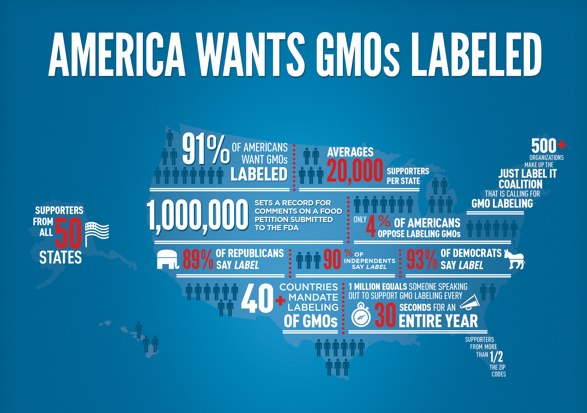
Given the potential consequences of unknowingly consuming genetically engineered products, it is simple common sense that people should be warned as to what they are eating; this is not to ban GMOs, but rather to ensure that consumers know just what they are buying and allowing them to make rational choices. The public opinion polling on the mandated disclosure of GMOs in food is heavily in favor of disclosure: A recent poll by Reuters concluded that 93% of Americans believe that genetically modified goods should be labeled for consumers. Individuals should be told what is in the food which they are buying and then be allowed to make a rational choice; the only way that this can occur is if all GMO-containing products are clearly labeled as such.


If an individual chooses to avoid genetically modified crops – whether it be health concerns, religious reasons, or simply a personal preference – it is an individual’s right to do so. Unfortunately, as there are no current regulations that force food suppliers to label goods which contain GMOs, it is virtually impossible for the casual consumer to determine just what they are eating. 


In the debate over the 2012 Farm Bill, Rep Bernie Sanders proposed an amendment which would require companies to disclose whether their products contain GMOs on its packaging; this amendment failed by a bipartisan vote of 73 to 26 in the Senate. As this amendment failed in the Senate by such a significant margin, it is essentially impossible that it will be included in the final bill (particularly because the House is even more hostile to such disclosure than the Senate). With the failed attempt by Rep Sanders to amend the 2012 Farm bill to include new disclosure regulations, it seems likely that such disclosure will not happen in the near future.


Without a federal law mandating disclosure of genetically modified materials in food, there is virtually no way for such laws to be enacted. On the state level, any attempt to pass legislation mandating disclosure would either fail to pass, or meet lawsuits by every major genetic engineering corporation. The threat of such lawsuits by powerful corporations presents a virtually insurmountable obstacle for any state level attempts to force disclosure, even on a smaller level. This is one issue that simply must be fought on the federal level and, unfortunately, this battle seems lost for now.

Monday, June 4, 2012

The Debate Over Debt


This post consists of two articles from the Boston Occupier Newspaper, both detailing plans to deal with the debt crisis afflicting Americans. My article, "A Plan for Debt", focuses upon the use of debt reform and the assistance of debtors within the system. Jay's article, "We Could Own the Banks", focuses upon debt refusal and the destruction of the current debtor system in the United States. Both of these articles provide valid points, and I will leave it up to the reader to decide which plan is most effective.  


A Plan for Debt

JOSH SAGER JUNE 4, 2012 0
This article is a part of our ‘Debate:’ series, a pair of op-eds published monthly in the Boston Occupier.  This month’s topic was ‘Debt Reform or Revolution?’.
Debt, whether originating from student loans, credit cards, mortgages, or healthcare, has become a serious problem in the United States. The mortgage crisis, and by extension the housing crisis, was a debt-driven catastrophe: it was the result of widespread inability of Americans to pay their debts in the face of predatory lending and job loss. In student loan debt alone, Americans owe over $1 trillion. When this sum is combined with debt from mortgages, credit cards, and medical expenses, we have a massive and rapidly growing debt problem in the USA, with no agreed-upon solution. The United States is rapidly becoming, if not already, a nation of debt. A large portion of the population is locked into a cycle of failed repayment and mounting interest, with no way out.
What should be done? I would argue that there are several initiatives that could widely ameliorate the negative effects of debt in the USA: adjustments of principle balances and interest rates for mortgage debt; punitive forfeiture of debt balance if a lender is shown to have engaged in fraud; federal assistance to students with loan debts upon graduation and the possible removal of student loan debt in bankruptcy; and finally, increased regulation of interest rates to reduce the prevalence of predatory lending. I will consider each of these in greater detail.
One effective way to mitigate mortgage debt, thus allowing people to remain in their homes, while allowing the banks to retrieve some of their money, would be to legislate a deal in which banks adjust the principle loan and interest rates so that they are in line with the actual value of the property. By reducing the principle loan and interest rates, more people would be able to afford to keep up with their mortgages, thus would be able to keep their homes. This would, in turn, increase the value of the surrounding houses and improve the general health of the housing market in the United States.  The federal government could compel such a deal between banks and the banks homeowners by threatening to return to banks their toxic mortgage assets, as allowed for in the current agreement between Fannie Mae and the banks, thus swamping them if they refuse to renegotiate mortgages.
In addition to this renegotiation with banks, there should be serious consequences for any lender who engages in fraudulent activity. I support total forfeiture of both the remaining principle loan and interest in any case where the bank engages in fraud. Banks should not be allowed to benefit from illegal practices, and people should not have to bear the costs of fraud. Practices that should cause forfeiture include, but are not limited to, the intentional misleading of prospective borrowers into high-risk mortgages, intentionally inflated interest rates, foreclosure despite up-to-date payments, and the use of robo-signing (systematic signing of loan papers by people who had no involvement in the process). By instituting severe monetary punishment on perpetrators of fraud, we can disincentivize fraud, as well as help its victims recover their rightful assets. Currently banks profit from fraud. We need to rewrite — and enforce — laws to ensure that fraud does not pay.
Student loan debt is a crippling weight on many graduates today. Unless a student comes from a wealthy family or receives a scholarship, it is likely that any private university (and many public universities) will cause thousands in loan debt. Because of a 1976 change to bankruptcy law, this debt is incapable of being removed through a declaration of bankruptcy, thus making it impossible to escape even in the event of financial ruin. In order to address this situation, I suggest several policies. First, student loan debt should able to be removed by bankruptcy, just like most other types of debt. Second, the federal government should create a national education fund in order to assist with the loans of all students who successfully graduate and qualify for assistance. This would be similar to Pell Grants, but on a much wider scale. Finally, student loan debt repayment should be capped at a percentage of annual income so as to increase the affordability of loans. Education increases the productivity of our entire society. When education becomes more affordable, everyone benefits — even those who do not directly receive debt assistance.
Banking institutions which give out loans must be heavily regulated in order to prevent abusive practices. Unfortunately, current laws are almost universally too lax and require a review. Banks should not be allowed to charge extortionate interest rates or hidden fees. Terms of use should not be misleading. A complete review of banking laws by experts, not lobbyists, would allow our government to identify future troubles and prevent the perpetuation and worsening of our country’s debt crisis.
While there are numerous ways to deal with a debt crisis, some argue that debt forgiveness (or “debt jubilee”) would be the most effective way to deal with the issue of debt facing Americans today. These people are correct, in that the solution is immediate and direct. However, the side effects of such an action would likely be devastating. Indiscriminate debt forgiveness, legislated by the government would destabilize the entire lending market. Lenders would have no reason to make new loans. If those who lend money have no certainty that they will get their money returned, with a modest profit, they simply would not lend money, especially not to the poor or middle class, who need loans the most.  This characteristic of the market disqualifies total debt forgiveness as a viable option for solving our country’s debt problems, at least as long as we intend to maintain a lending system similar to the one we have now.
Debt is an issue that must be dealt with, and quickly if we hope to mitigate long-term damage to our country. A comprehensive plan, which prioritizes the economic health of the average person over that of the banker, is the only course that will stabilize our debt situation in the short term and avoid long-term catastrophe.

_____________________________________________________________________________________________

We Could Own the Banks

JAY JUBILEE JUNE 3, 2012 0
This article is a part of our ‘Debate:’ series, a pair of op-eds published monthly in the Boston Occupier.  This month’s topic was ‘Debt Reform or Revolution?’.
The average US household debt burden has reached oppressive and unprecedented levels.  According to the Federal Reserve, in 2010, total US household debt stood at $13.5 Trillion. This calculates to over $44,000 per person, or about 122% of total disposable income.  Increasingly Americans owe more than the own in this world (even as the top 1% owns more than ever).  Why are people in so much debt in the first place?  This rising debt is the effect of an exploitative and unsustainable system.
Contrary to those who moralize about “irresponsible” consumer spending, the single largest cause of the rising average US debt-burden is a rise in workplace exploitation.  Despite working harder and more efficiently year after year, US workers—those of us who are “lucky” enough to find jobs—continue to see our wages stagnate, or even decline.  Corporations and employers (aka “the 1%”) are getting more out of us, while paying us less.  Profits have gone through the roof for capitalist firms, while workers have been compelled to borrow to maintain the markers of “middle class” life: a car, a house, a college education for their kids.
Rising college tuition and healthcare costs are important secondary causes of the debt-boom, as are government policies that have replaced federal educational grants with loans. (As recently as 1980 Pell Grants covered 69% of public college costs; now they cover less than 35%.) Federal “Student Aid” has ceased to be a subsidy for education, and become largely a subsidy for the Finance Industry.
Chart from the Federal Reserve Bank of NY, showing the breakdown of tool US Household debt. Click through twice to enlarge.
In this context of stagnating wages, the credit-debt complex came to the rescue as a double “solution,” at least for a time.  On the one hand, credit served as a means of buoying consumer demand across the system (allowing people to buy more from businesses than they could without the loans).  On the other hand, it gave finance capitalists one more easy way to profit (via interest) off of the very worker deprivation being created by heightened workplace exploitation.
But all this debt makes a volatile economic foundation.  As we saw in 2007 with the sub-prime mortgage crisis and the bursting of the housing bubble, when poor and working-people become unable to repay their debts, the whole elaborate financial edifice can come crashing down.
What if we harnessed this power of debt refusal in a politically conscious way?
There is nothing like being deep in debt to make you feel completely alone and powerless.  Increasingly, however, this isolation is an illusion.   The numbers of people drowning in debt in this country is growing all the time, as is the amount of US debt per household.  (The average college graduate now enters the “real world” already $30,000 in debt, the average graduate student, with far more than that.) There is potential power in these numbers.
There is a saying that goes: “If you owe the bank $100,000, the bank owns you.  If you owe the bank $100 million dollars…You own the bank.”   It is long-past time that those of us whose lives are crippled by chains of debt took this idea to heart. Student loan debt alone is estimated at over $1 Trillion.  Together, we, the student debtors united, could own the banks.
The basic premise of collective bargaining, that workers can (only) gain equal power with employers by coming together and threatening to withhold the source of the employers’ profits (namely, our labor)applies to debtors as well.   Banks are dependent on our debt payments. Thus, the debt that individually makes us feel helpless, if pooled and wielded collectively, can become the source of great power.  Weakness, combined, can be flipped into strength.
Such a debt-refusal need not be an act of random sabotage, aimed simply at disrupting bank operations, or at “sticking it to the man.”  Rather, our debtors union could project demands that would unite broad sectors of the 99%.  We could force the Banks to reduce their interest rates, to cancel the principle they are “owed,” to renegotiate underwater mortgages, etc.  We might even use this debtor-power to leverage more aggressive political demands: like getting the banksters to cough up the funds necessary to fund free public education (estimated at approximately $50 Billion per year).  Compared to a traditional labor union, a debtors union could have the benefit of  bringing together people across traditional workplace lines, while rallying the public against some of the most unpopular institutions in our society.
A student debt revolt can be the spark.  Targeting those who are profiting from our financial slavery, we can help catalyze a broader debt resistance movement, one encompassing medical, housing, as well as education debts.  The bonfire of student debt statements can light the sky, hearkening rebellion in other parts of this debt-chained world.  Even fairly small groups of well-organized debt-resisters could have such a catalyzing effect, sparking broad conversation about the oppressive role debt plays in all our lives.  Such an act might resemble the burning of draft cards during the Vietnam War; it moves beyond protest and complaint, towards resistance, courageously marking a refusal to participate in an oppressive and irrational system.  And rallying others to do the same.
Fundamentally, the goal of such a debt refusal campaign should not simply be to “mess shit up” but to expose the inhumanity of the way the current system operates.  Education, Healthcare, Housing: these are things that should be considered rights, guaranteed to all.  Through our debt-refusal we will be dramatically asserting that people should not have to go into debt to have their basic human needs met.  People should not be forced to go into debt to receive medical treatment, to have shelter over their heads, or to attend college (especially when attending college is considered a prerequisite for landing a job in the first place).   A social system that provided these necessary goods to people as a matter of right would  be one in which the sorts of debt burdens that fill our lives with dread and anxiety could be abolished for good.
With high debt loads and high unemployment rates facing most college graduates, let’s face it: many of us are going to be defaulting on student loans anyway.  It is long past time that we shred the shame of default, that we recognize the systemic causes of this debt, and that we refuse to treat this dream-strangling system as legitimate.  If we Occupy Student Debt and as one, we can burst the chains of mental slavery.  Together, we can own the banks.

Sunday, June 3, 2012

Progressive Tactics: Retaking Patriotism


By Josh Sager

Pat Bagley - Salt Lake Tribune - Patriotism - English - Flag, Red White and Blue, Old Glory, Patriotism, McCain, Obama, Flag Pin, Fourth of July

All too often in the United States, conservative Republicans are considered the “patriotic” political group, while liberals and progressives are labeled as “not real Americans” or “apologists” for America; these labels are extreme mischaracterizations and must be debunked by non-conservatives.

By portraying themselves as “the patriotic party” Republicans are able to take an automatic high ground on many policy debates which revolve around national defense or “traditional American values”. If the public has the pre-conceived notion that a party has an advantage over other parties in the quality of patriotism, it biases the public to support defense policy created by that party; we see this effect in the portrayals of the Republicans as the “strong on defense” party during the latter half of the 20th century.

The current discrepancy in the perceived patriotism of the conservative right and other parties has been due to several factors:

  • 1.      The modern conservative movement has consistently supported high levels of military spending and labeled all reductions in spending as detrimental to defense. While untrue, this claim has created the perception in some that non-conservatives are risking endangering the country through cutting defense funding.
  • 2.      The conservative movement has made a concerted movement to portray themselves as patriotic, while denigrating all others as un-American. As this idea has been repeated so often, and not challenged by the media, it has become “common knowledge”, regardless of its inaccuracy.
  • 3     The “war on terror” has been a massive plank in the conservative agenda for the last decade and has allowed them to pursue aggressive defense policies. The neo-conservative movement instituted unreasonably aggressive policies after 911 (ex. war in Iraq) and there has been a lack of major terrorist attacks on American soil since; this has allowed the conservative movement to claim that their policies have protected society, and that the less reactionary policies of other political parties could spell disaster for the country.

In order to retake the language of patriotism, we must define the term - according to the Oxford English Dictionary, Patriotism is defined as such:

Patriotism: the quality of being patriotic; vigorous support for one’s country: a highly decorated officer of unquestionable integrity and patriotism

If we look at the central ideological pillars of modern American conservatism - cutting taxes in order to shrink the government, increasing military activities, and imposing a Christian conservative social policy – we see that these policies are in no way patriotic. Modern conservatives are intensely nationalistic in their rhetoric but, when it comes to personal sacrifice for the good of the country, often fall short of their ideals.
Put plainly: Which ideology is truly patriotic?
  •       The ideology which promotes radical individualism and a diminishing of social supports, or the ideology which promotes personal sacrifice in support of the country?
  •       The ideology which supports wars abroad, but no investment in the country, or the ideology which supports domestic investments and diplomacy abroad?
  •       The ideology which supports cutting taxes for the wealthy, paid for by raiding the social security fund, or the ideology which supports asking those with money to pay their fair share?
  •       The ideology which intentionally uses gridlock, falsehoods, and hostage taking to facilitate their policy agenda, or the ideology which is willing to compromise because refusing to do so would harm the American people? 

Economic Patriotism

Cutting taxes and shrinking the government is, by definition, a policy which attempts to reduce the very government that the conservatives attempt to portray themselves patriots of.  By their own admission, conservatives wish to shrink the government of the United States, reduce taxes on the wealthy, and grant more powers to the corporate private sector; none of these policy ideals are patriotic, as none of them are aimed at supporting the American people as a whole, or the American government.

It would be possible to argue that conservative policies are good for society, thus patriotic, but, as they policies have been shown to be ineffective, this argument holds little weight. The conservative movement is currently pushing policies which, while beneficial to a few, have been shown to be extremely damaging to society as a whole (Ex. tax cuts for the rich, deregulation, austerity); the conservative movement’s pushing of failed policy makes them either patriotic yet profoundly unintelligent, or greedy, corrupt and unpatriotic.

The current conservative economic agenda does not purport to benefit society, but rather institute a social Darwinian system of “rugged individualism” and complete self-reliance – reducing social programs, privatizing public services, and signing power over to the corporations. The conservatives assert that privatization will allow the competent to advance, without the need to pay of the less able. By their own admission, the conservative economic policy agenda is aimed at supporting a small percentage of American “job creators”, and removing the “unproductive” members of society from the welfare rolls. By sacrificing the interests of the majority, in service for the “job creators”, the conservative economic ideology is inherently anti-patriotic (antithetical to the health of the American public or government).

Progressives should make the argument that paying taxes to support society is, in and of itself, patriotic. Sacrificing some personal wealth (through paying taxes), in order to support the improvement of the social infrastructure and the general welfare of the American people, is an inherently patriotic act; avoiding taxes and constantly attempting to strangle the government, all for personal  monetary gain is entirely selfish and unpatriotic. Progressives and Democrats should begin making the argument that taxes are not simply a matter of economics, but rather one of a patriotic duty; those who love this country and wish to improve it should have no problem sacrificing a portion of their wealth to support it.

Here are a few talking economic patriotism points:
·         Patriotic Americans should have no problem giving a reasonable percentage of their wealth to support the country which they love.
·         Paying taxes is a patriotic act; it is a personal sacrifice for the welfare of the country.
·         Claiming to love the United States, but publicly decrying taxes, is a contradiction – it is proof that the speaker only supports the country with words, rather than acts.

Defense-Oriented Patriotism
Modern American conservatives are, virtually without exception, supporters of increasing military spending. Although there are libertarian Republicans who reject increased military spending, these politicians are in a clear minority and rarely sit in positions of power within the conservative movement; these libertarians do not deserve to be tarred with the same brush as the rest of the conservatives, as they truly believe that their policies are improving the health of the country. Support of increasing military spending is often conflated with a sense of patriotic defense of country, thus conservative politicians can us this to claim high levels of patriotism.

Many in the United States make the mistake assumption that the more money which is spent on defense, the safer we will be; this is not the case, and can often lead to a misappropriation of funds. Quite often, defense contractors lobby politicians - on both sides of the isle – in order to increase military spending, thus the profits of the defense corporations. The result of such spending is most often wasted resources, weapons which the USA does not need, and increased hostilities, not improvements to national security. 

The perfect example of a redundant, yet defense corporation friendly program is the F-22 Raptor program. The F-22 is a highly advanced, stealth-fighter jet, which was developed by Lockheed Martin and promoted as the future of air combat. The United States government has spent over $74 billion[1] over the entire life of the F-22 program, yet this fighter has never seen action - nor is there a strong likelihood that it will in the near-future. The F-22 program was a massive waste of taxpayer money and likely only remained active due to lobbying efforts by Lockheed Martin. Lockheed Martin has spent massive amounts of money on lobbying - $15 million in the 2011 alone – and is able to sustain even ineffective programs through “contributions” to politicians.

Proposing increased defense funding and pushing for needless wars, all for the benefit of - and contributions from - lobbyists, is not patriotic; it is dangerous and self-serving. The individual politicians, as well as the corporations which lobby them to increase military spending benefit from increased militarism, but the rest of the country suffer. The defense budget eats into the funding of useful programs, thus reducing the resources available to programs which are truly beneficial to the American public. Wars based upon militarism, rather than need, only results in profits for the suppliers of the tools of war and pain for the countries involved in the conflict.

Attributing patriotic motives to everybody who promotes increased spending and war makes no logical sense, and results in many who simply wish to be paid by lobbyists to be labeled as patriots. The conservative movement (particularly neo-conservatives) promotes endless war abroad and increased money wasted upon defense corporations.

Progressives should make a clear and concise case to the American public that the conservative positions of war and military waste are simply not patriotic; such policies harm the United States, eat resources which can be used to support domestic investment, and can promote increased anti-American sentiments abroad. These positions are caused by either a complete lack of understanding of the needs of the military, a desire to support the defense industry, or an ideological belief that militarism is beneficial to the country. None of these justifications are rational, nor are they patriotic.

Here are a few defense-oriented patriotism talking points:
·         A patriot is somebody who risks war only as a last resort, out of the fear that their countrymen will die in a pointless conflict.
·         Supporting excessive military spending is not synonymous with patriotism; as excessive spending is wasteful and pointless, these people are simply warmongers or the tools of lobbyists.
·         A patriot doesn’t support pointless war abroad and a decaying infrastructure domestically.

Tuesday, May 22, 2012

Petition: Debt Ceiling Deal


Tell Republicans not to Threaten another Government Shutdown

PETITIONSPOLITICS — BY  ON MAY 18, 2012 11:18 AM 

Sign the Petition: http://forcechange.com/21178/tell-republicans-not-to-threaten-another-government-shutdown/


Target: Speaker of the House John Boehner and Senate Minority Leader Mitch McConnell
Goal: To demand that the Republican Party honor the debt ceiling deal so the economic recovery is not put at risk.
In 2011, there was a near shut-down of the federal government over an increase to the debt ceiling. In order to reach an agreement, thus preventing a shutdown, a deal was struck between the Republicans in the Legislature and President Obama. Unfortunately, recent comments by Republican politicians point towards an impending reneging on the terms of this deal, potentially causing another shutdown.
The deal reached between Obama and the Republican legislature had multiple parts, and didn’t give anybody everything that they wanted. The debt ceiling was raised by $400 billion immediately upon passage of the compromise, and could periodically be raised further by the Obama Administration, but these increases could be subject to a congressional motion of disapproval (which Obama could simply veto).
In return for capitulating on the increase to the debt ceiling, the Republicans got several concessions:
  1. Spending was to be cut by more than the debt increase.
  2. Democrats capitulated on the desire for tax increases.
  3. A balanced budget amendment to the constitution was brought to a vote (it failed).
  4. A bipartisan super-congress was created to deal with debt reduction, and automatic triggers for a lack to agree guaranteed cuts.
Despite the terms of the debt deal being agreed upon, Republican Party leaders have recently signaled a desire to make the debt ceiling a fight again. In an interview this week, John Boehner signaled a potential impending fight over the final installment of the debt ceiling increase, as agreed upon last year: “Allowing America to default would be irresponsible. But it would be more irresponsible to raise the debt ceiling without taking dramatic steps to reduce spending and reform the budget process.”
Regardless of one’s partisan affiliation, most people can agree that another potential government shutdown will cause immense damage to the country’s fragile economic recovery and would harm millions of Americans. Millions of American families would not receive benefits and could fall below the poverty line and, depending upon the length of the shutdown, government jobs could be lost; we cannot afford either of these consequences, particularly considering the absolutely unnecessary nature of the fight. A deal was struck to avert this crisis last year, and those terms (whether or not one likes them) should be stuck to by both Democrats and Republicans.
This petition is intended for the two top legislative branch Republicans, John Boehner and Mitch McConnell, and is intended to dissuade them from reneging upon the 2011 debt ceiling compromise. We, as a country, cannot afford needless political brinksmanship in our currently fragile economic situation.

PETITION LETTER

Dear Speaker of the House John Boehner and Senate Minority Leader Mitch McConnell,
As the federal legislative branch leaders of your party, you are in a position to avert an impending political crisis. The debt ceiling must be raised again, as agreed upon during the negotiations last year, lest the fragile economic recovery collapse. The only serious consequence of the last debt ceiling fight was a downgrade by the rating company Standard and Poor’s, but we may not be that lucky this time.
Whether or not you fully support the terms of the debt ceiling deal, it remains that this deal was willingly struck and has been held to by the Democratic Party. A vote was held on your constitutional amendment mandating a balanced budget, spending was cut, the super-congress met for weeks, and no new taxes have been levied, thus showing that the Democratic party has held its end of the bargain.
The Republican Party should not violate the terms of their side of the debt ceiling deal, lest they lose all future bargaining credit and risk causing the U.S. economy to fall back into recession. If the Democratic Party cannot trust the Republican Party to keep their end of a political agreement (or vise-versa), the process of debate and agreement between the parties decays.
Sincerely,
[Your Name Here]

Thursday, May 17, 2012

Petition: Reinstate Glass-Steagall


Protect America from Future Banking Collapses

CONSUMER PROTECTIONPETITIONS — BY  ON MAY 17, 2012 2:00 AM 


Sign the Petition: http://forcechange.com/21087/protect-america-from-future-banking-collapses/


Target: The Democratic National Committee
Goal: To convince the Democratic National Committee to adopt the reinstatement of a law which insulates the country from future banking collapses as a major policy platform for 2012.
For most of the 20th century, the Glass-Steagall Act separated investment banking institutions from investment banking firms. This separation was intended to prevent investment bankers from using other people’s money, obtained through commercial banking, in their investments. For decades, Glass-Steagall protected Americans from banking crises but in 1999, it was repealed. The repeal of Glass-Steagall created increased instability in the banking industry, promoted reckless investing, and eventually contributed to the financial collapse of 2008.
With the removal of Glass-Steagall, there exists a system of socialized losses and privatized gains in many investment banks. When the investments of the bankers gain money, they take the gains as income and repay the commercial banking wing of their bank; despite suffering no risk, these bankers take home huge profits for their bets on investments. However, when the investments of the bankers lose money, the investors socialize the losses through passing the debt back to the commercial banks and incur no personal losses. By separating risks and the gains, a moral hazard is created in the industry of banking and there is great potential for banking crises.
It is very easy for somebody to make unreasonable bets with other people’s money and, in the absence of Glass-Steagall, this philosophy is endemic in the banking industry. Risk is disregarded when making investments because there is no personal downside to the investor, only the potential for profit. Once investments go wrong (and they inevitably will), the government must either bail out the commercial bank, in order to protect the banking patrons (anybody who has money in a large bank), or leave these people responsible for the debt created by the mal-investment.
By signing this petition, you will be showing your support for a return to sane banking policy to the Democratic National Committee. If enough Americans show support for reinstating Glass-Steagall, it will compel the DNC to get behind it as a major policy position.

PETITION LETTER

Dear Democratic National Committee,
A return to the Glass-Steagall Act would help stabilize the banking industry, curb risky investing, and decrease the likelihood that another bank bailout would be necessary to protect the savings of the American people. It makes no sense to court a banking disaster, for no benefit other than increased profits for a small minority of bankers; we have seen what the end result of this path is.
While several Democratic politicians and candidates have endorsed a reauthorization of Glass-Steagall, the Democratic Party as a whole has not named it to be a core policy position. The DNC should throw its full support behind a return to Glass-Steagall. A return to Glass-Steagall Act regulations is not just good policy but also an important rallying point for increased accountability for the banks.
I, as well as everybody else who signed this petition, implore you to take up the fight for Glass-Steagall and to restore sanity to our banking regulations. We will support your efforts to protect our savings as well as to prevent future banking collapses and stand behind your efforts on our behalf.
Sincerely,
[Your Name Here]

Saturday, May 12, 2012

Why Conservatives Love “States’ Rights”


By Josh Sager


Modern American conservatism is based around an anarcho-capitalist economic policy (or sometimes a crony-capitalist policy) and a fundamentalist Christian social policy – somehow figuring out a way to create a party which integrates the ideologies of Ayn Rand and Pat Robertson. In order to facilitate the inception of both segments of their political ideology, conservatives have used the argument that “states’ rights” should reign supreme.

The ideal of “states’ rights” often, if not always boils down to the ideology that power should be centralized in the states and that the federal government should not interfere with laws passed by the states. By concentrating power at the state level, proponents of “states’ rights” believe that policy can be more accurately tailored towards the needs of the citizens. Unfortunately, the reality of power concentrated in the state level is that it is far easier for corporations to buy politicians and for politicians to oppress social minorities.


For economic policy, the right wing believes in massive deregulation and reduction of taxes, creating a situation where government is little more than a vehicle for national defense. The ideal of a virtually non-interventionist federal government on economic issues is based around the argument that government should give the economy over to the market and should let capitalism decide economic results. This ideology is fundamentally small government and is incompatible with a strong federal or state government.


Conservatives use “states’ rights” arguments to support their economic ideology because, put plainly, it is far easier for corporations and wealthy interests to buy state governments than it is for them to buy a federal government. As many corporate interests are aligned with the conservative position on “small government” economic policy, conservatives have simply joined corporate interests in an alliance to bring about their ideology. It requires far less money in order to buy state elected officials than federal officials, and efforts can be micro-targeted to specific locales (coal companies just buying the Virginia state government rather than the federal government).  In areas where corporations buy the government, regulations and taxes fall (Ex. Texas). The alignment between conservative and corporate economic views means that the most effective way for conservatives to bring about their economic ideal is to simply concentrate power in the states (by weakening the federal government) until corporate interests bring about change for them.    


In terms of social policy, the right wing supports allowing right wing Christianity to infiltrate the government and decide upon social policy; the primary issues created by this are the rejection of science, the “war on women” and the persecution of gays. The right wing social ideology requires a relatively powerful government, which is capable of regulating compliance with social policy created by the religious right.


Socially conservative activists use “states’ rights” arguments to localize civil rights/religious debates, thus making it easier to pass controversial social legislation. It is far harder to pass controversial social or religious legislation (Ex. restricting abortion) through the federal legislative process than to simply focus on a few states; this is simply due to the fact that some states are very socially conservative and, without the moderating counterbalance of liberal state, very likely to pass conservative legislation. By passing legislation on the state level, one state at a time, conservatives are able to gradually impose their social views on the USA as a whole.


Without a strong federal government to restrict the discriminatory social policy of the conservative movement, many states would gradually descent into a type of theocracy; vast portions of the south and southwest (bible-belt states) would be overtaken with social policy based upon “Christian values”.


The conservative movement has recognized the moderating influence of the federal government on state level social policy and has attempted to restrict the powers of the federal government through the courts and by creating gridlock on the federal level. A perfect example of this obstructive tactic was demonstrated during the 2011 debt ceiling negotiations, where the House of Representatives held up all debt talks unless the Democrats agreed to discuss new abortion restrictions.


While the two major ideological positions of conservatives are fundamentally incongruous – due to the support of small government economic policy and big government social policy – both benefit from the promotion of the same “states’ rights”. With the weakening of the federal government and the strengthening of the state governments, it is possible for right wing agenda to take control of entire states (Ex. Mississippi).  Religious and civil rights issues rarely affect business, so as long as the state governments which are bought by the corporations only regulate social issues, they are unlikely to face corporate pushbacks. By increasing the power of the state to regulate social issues, while decreasing its power to regulate economic issues, the conservative movement is able to take control over wide swathes of the USA and implement both segments of their policy agenda without internal conflict.


Liberals and progressives must recognize the true intents of the conservative “states’ rights” strategy and respond. Progressives must keep federal regulatory agencies and civil rights protections as strong as possible on the federal level, so as to prevent conservative states from repealing the basic protections in our society.


On a purely economic level, due to the fact that the conservative movement is supported by corporate interests (and their money), they have an advantage over the progressive movement in many states. While liberal states, such as Vermont or Massachusetts, are unlikely to enact conservative economic policies, the regulatory race to the bottom will eventually drain business way from these states towards those which are more “business friendly” (similar to why we outsource to China). By strengthening the federal government, it is possible for progressives to create a floor level of regulation, under which no state can deregulate past; this will mitigate the effects of very conservative states’ attempts to race to the bottom.


In the argument over social policy issues in the USA, the conservative use of the “states’ rights” argument is a double-edged sword. On one hand, the conservatives wish to use the “states’ rights” argument to support their social policy, yet they fear the progressives utilizing the same strategy in states which they control. Just as conservative states may ban gay marriage or restrict abortion rights, progressive states may allow gay marriage or restrict gun rights. Progressives should strengthen rights in the states which they control, while focusing upon transitioning these rights into legislation on the federal level.


In terms of social issues, there is little for progressives to do for conservative states other than to retain strong federal guarantees for civil right and restrictions on overtly religious legislation. A majority of voters in some states may support repealing civil rights legislation and replacing them with biblical laws, but the majority of the country clearly does not. By keeping a high standard for progressive social issues legislation (Ex. protecting abortion and voting rights) and utilizing the supremacy clause of the constitution, it is possible for progressive activists to affect policy in otherwise unreachable states.  

Thursday, April 26, 2012

A Plan for Debt


By Josh Sager

Debt, whether it originated from student loans, credit cards, healthcare or mortgage, has become a serious problem in the United States. The mortgage crisis, and by extension the housing crisis, was a debt driven catastrophe – the result of widespread inability of Americans to pay their debts in the face of predatory lending and high rates of job losses. In student loan debt alone, Americans owe over $1 trillion to lenders; when combined with the sum costs of mortgage debt, credit card debt, and personal debt incurred from medical expenses, we have a massive and rapidly growing debt problem in the USA, with no agreed upon solution. The USA is rapidly becoming, if not already, a nation of debt, where a large portion of the population is locked into a cycle of debt and repayment with no way out.

With the huge issue of debt, we encounter a debate over what should be done about this widespread problem. I would argue that there are several initiatives that could widely ameliorate the negative effects of debt in the USA: Adjustments of principle and interest rates for mortgage debt; punitive forfeiture of debt balance if the loaner has been proven to have engaged in fraud; federal assistance to students with loan debts upon graduation as well as making it possible to remove student loan debt through bankruptcy; and finally, increased regulations on interest rates in order to reduce the prevalence of predatory lending.

One effective way to mitigate mortgage debt, thus allowing people to remain in their homes, while allowing the banks to retrieve some of their money, would be to legislate a deal in which banks adjust the principle loan and interest rates to be in line with the actual value of the property. By reducing the principle loan and interest rates, more people will be able to afford to keep up with their mortgages, thus will be able to keep their homes; this will, in turn, increase the value of the surrounding houses and increase the general health of the housing market in the USA.  The federal government can compel such a deal by the banks by threatening to return the toxic mortgage assets to them, potentially swamping them, if they refuse to renegotiate mortgages.

In addition to renegotiating with banks which have not engaged in fraud, there should be consequences for any lender who engages in fraudulent activity: I support total forfeiture of both the remaining principle loan and interest in any case where the bank engages in fraud. Banks should not be allowed to benefit from illegal practices, and people should not have to bear the burden of the costs of fraud. Practices that could cause forfeiture include, but are not limited to, the intentional misleading of prospective lenders into high-risk mortgages, intentionally inflated interest rates, foreclosure despite up to date payments, and the use of robo-signing. By instituting severe monetary penalties to all fraud, it is possible to disincentivize the use of fraud, as well as to mitigate its effects on those who are defrauded.

Student loan debt is a crippling weight on many graduates today. Unless a student comes from a wealthy family or receives a scholarship, it is likely that any private university will cause thousands in loan debt – this debt is incapable of being removed through a declaration of bankruptcy, thus it is harder to get out of then other debt. In order to deal with student loan debt, I suggest several policies: First, student loan debt should be removed by bankruptcy, just like most other types of debt. Second, the federal government should create a national education fund in order to assist with the loans of all students who successfully graduate and qualify for assistance - this is similar to Pell grants, but on a much wider scale. Finally, student loan debt repayment should be capped at a percentage of annual income, so as to increase the ability of all students to afford their loans. By assisting those who desire an education and to be a productive member of society through becoming educated, we can all benefit, regardless of whether or not we receive debt assistance.

Banking institutions which give out loans must be heavily regulated in order to prevent abusive practices. Unfortunately, current laws are near-universally too lax, and require a review. Banks should not be allowed to charge extortionate interest rates, give out hidden fees, or intentionally mislead their customers for a profit. I believe that a complete review of banking laws by experts, not lobbyists, would allow our government to identify future trouble areas and prevent the continuation of our country’s debt crisis.

While there are numerous ways to deal with a debt crisis, some argue that debt forgiveness (or “debt jubilee”) would be the most effective way to deal with the issue of debt facing Americans today: These people are correct, in that the solution is immediate and direct, however, the side effects of such an action would likely be devastating. Indiscriminate debt forgiveness, legislated by the government, would certainly fix the problem of debt in the USA but it would destabilize the entire lending market to the point where future loan seekers would likely be unable to obtain loans. If those who lend money have no certainty that they will get their money returned, with a modest profit, they simply would not lend money – particularly to the poor or middle class who need loans the most.  This characteristic of the market disqualifies total debt forgiveness as a viable option to solving our country’s debt problems, for as long as we intend to maintain a lending system similar to the one we have now.

Debt is an issue that must be dealt with, and quickly if we hope to mitigate long-term damage to our country. A comprehensive plan, which prioritizes the economic health of the average person over that of the banker, is the only way which we will stabilize our debt situation in short-term, and avoid a long-term catastrophy.